

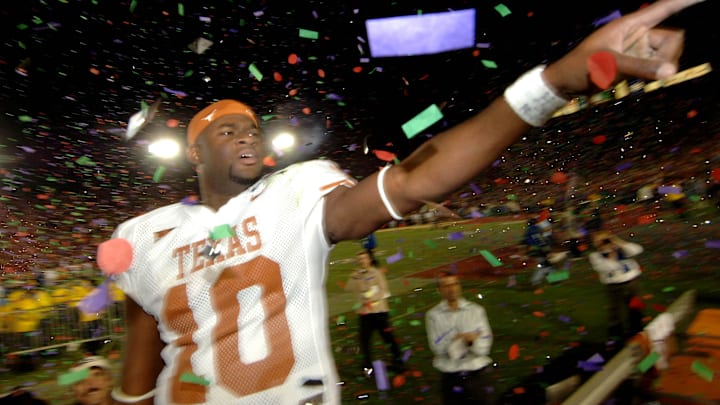
The hardest throw to make at Texas isn’t the deep ball. It’s the pass you attempt after 100,000 fans question whether you’re the guy. You aren’t just another college quarterback. You become the CEO of an enterprise. Every win magnifies you. Every loss indicts you. Everything the program succeeds at — and everything it fails at — puts you under a microscope. The expectation? National championship. Anything less feels like failure; that’s the standard in Austin.
The Weight of the horns
Playing quarterback at Texas Longhorns isn’t like playing at most schools. This isn’t just about football. It’s about history. Relevance. Identity. The brand carries built-in critics, and the spotlight never dims. Talent alone won’t save you here.
You will compete against players who are bigger, faster, and just as decorated. Five-star prospects often arrive believing the job is secured. It isn’t. At Texas, you earn everything. Confidence here isn’t loud. It’s constructed — forged through scrutiny.
The shadow of Vince Young
Every quarterback who steps onto the field at Darrell K Royal–Texas Memorial Stadium walks into history. And history has a face. The myth is rooted in fact: the 2006 Rose Bowl. 2006 Rose Bowl wasn’t just a championship game. It became the measuring stick.
Texas fans don’t just want efficiency — they want moments. Highlights. Legacy performances. Are today’s quarterbacks judged against a once-in-a-generation talent? Yes. Fair or not, that’s the standard.
The multiplier: social media
Pressure used to live in newspapers and talk radio. Now it lives in your pocket. One bad quarter turns into “start the backup.” One interception becomes “portal watch.” One hesitation goes viral. Fear shrinks processing speed.
And when you’re the quarterback at Texas, noise isn’t background — it’s constant. Direct messages. Fan edits. Transfer speculation. The question isn’t whether you hear it. The question is whether you can function through it.
The CEO effect
Texas operates inside one of the most powerful NIL ecosystems in college football. You can secure brand deals before you ever produce on the field. Public expectation can quickly become public investment. Boosters expect returns. Does early financial opportunity accelerate maturity? Or amplify anxiety?
A Texas quarterback must lead the locker room, represent sponsors, handle media obligations, maintain elite academic standards, and win football games — all between the ages of 19 and 21. That’s not just football. That’s executive leadership.
What Texas actually needs
Anyone can throw it 50 yards. Anyone can run a fast 40. Everyone was a star in high school. That doesn’t separate you here. The next great Texas quarterback will: Be the voice of reason in chaos Respond to interceptions with composure, block out media noise, play with controlled aggression, and anticipate instead of reacting. The difference won’t be arm strength. It will be emotional regulation under pressure.
The Steve Sarkisian factor
The offense Sarkisian deploys is structured and precise. Structure doesn’t eliminate pressure — it exposes mental cracks faster. We saw flashes of that learning curve with Arch Manning last season. In this system, hesitation kills rhythm.
Timing is oxygen. Anticipation is mandatory. You must trust your receivers before they’re open and release the ball before doubt creeps in. Mental clarity matters more than raw talent. Can you process fast — and still stay poised?
Final truth
Here’s what nobody wants to admit: Quarterbacks at Texas don’t fail because they can’t throw. They fail because they can’t withstand the weight. Stat lines don’t define you in Austin. Adversity does. And the hardest throw you’ll ever make isn’t downfield. It’s the one you make when the entire state is watching.
 Add us as a preferred source on Google